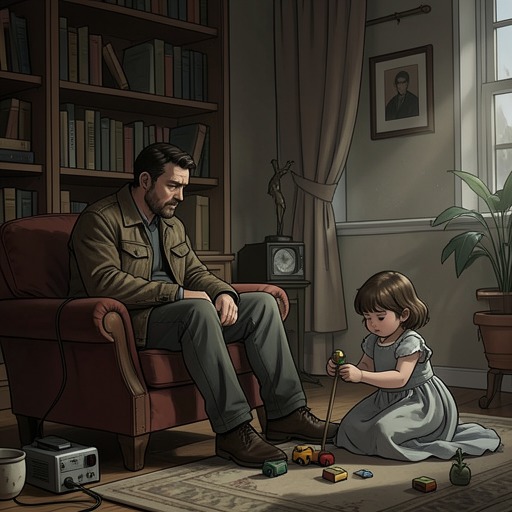
Gertrud
The ReaderGertrud is Michael Berg’s fellow law student, wife, and the mother of their daughter, Julia. Their relationship offers a concrete family life after Michael’s earlier relationship with Hanna Schmitz, but it cannot displace that history: he keeps Hanna secret, compares the women, and experiences his marriage as persistently wrong. Gertrud and Michael divorce when Julia is five, part without bitterness, and remain loyal to one another, while the effects of their separation are felt most sharply by their daughter.
Identity and Background
Gertrud meets Michael at a ski lodge. When the others leave at the end of vacation, she stays until he is released from the hospital and can take him home. Their connection is rooted in shared circumstance and study: Gertrud is studying law, as Michael is, and they work together, pass their examinations together, and begin their legal clerkships together. Their marriage follows Gertrud’s pregnancy, joining a developing professional partnership to the practical demands of family life.
The arrangement of their later household is modest and modern rather than the expansive family life Michael imagines as an alternative. They live in a three-room apartment on the edge of the city; both work as legal clerks, and they have a daughter, Julia. Those details matter because Michael’s account of the marriage is not a rejection of Gertrud’s competence or loyalty. He describes her as smart, efficient, and loyal, while locating the fracture in the private comparisons he cannot stop making.
Marriage and Michael’s Silence
Michael does not tell Gertrud about Hanna. He rationalizes the silence by assuming that people do not want to hear about a partner’s earlier relationships unless the present relationship fulfills its promise. The omission is not simply a missing piece of biography: it leaves Gertrud unable to know the history that shapes Michael’s judgments and emotional responses.
He repeatedly measures life with Gertrud against life with Hanna. Even when the couple hold one another, he feels that something is wrong and attributes the mismatch to Gertrud herself: in his perception, she moves, feels, smells, and tastes wrongly. He hopes the feeling will pass and wants to be free of Hanna, but it does not. The contrast exposes the limits of Michael’s attempt to begin again: instead of meeting Gertrud without a prior standard, he carries the former relationship into their marriage as an unspoken test.
The narrative presents this comparison as Michael’s continuing perception, not as an objective deficiency in Gertrud. His description makes clear that the marriage’s emotional distance is bound up with what he withholds and with the remembered relationship he cannot leave behind. Gertrud’s loyalty and practical capability do not solve a conflict whose central terms Michael has concealed from her.
Family Life and Divorce
Michael and Gertrud divorce when Julia is five. Neither can keep the marriage going, but they separate without bitterness and retain their loyalty to each other. The breakup therefore ends their shared household without turning them into enemies; their continuing connection is expressed most clearly through their responsibilities toward their daughter.
Julia longs for the warmth and security she associates with her parents together. When Michael and Gertrud are open and warm with one another, she responds as though that closeness is her natural element. When she senses tension, she moves between them to reassure them that they are good and that she loves them. She also longs for a little brother and, Michael thinks, would probably have welcomed more siblings. Her actions make the costs of the separation visible through the child’s effort to preserve a family atmosphere that the adults can no longer sustain.
For a long time Julia does not understand what divorce means. When she visits Michael, she wants him to stay; when she visits Gertrud, she wants her mother to come too. At departures, she watches Michael from the window as he gets into the car, and her sadness breaks his heart. He believes that the parents have denied her not only a wish but a right, and that their shared decision does not lessen his guilt. His account thus distinguishes the absence of bitterness between the adults from the pain their daughter experiences.
Work, Separation, and Later Life
After their state examinations, Gertrud moves directly into the judiciary, while Michael remains at home to care for Julia. Gertrud has her hands full as she begins her career; the arrangement continues while Michael delays choosing his own legal profession and Julia is still young. Once Gertrud has overcome the difficulties of starting work and Julia enters kindergarten, Michael has to decide what to do.
Michael cannot imagine himself in the roles he saw lawyers occupy at Hanna’s trial. A professor of legal history offers him a research position, and Gertrud calls his acceptance an evasion—an escape from the challenges and responsibilities of life. Michael acknowledges that she is right and that he feels relieved to escape. His subsequent move from the university to a research institution extends that retreat into a career organized around legal history, in a niche where he needs and disturbs no one. Gertrud’s judgment identifies a pattern that outlasts the marriage: Michael’s choice of work, like his silence about Hanna, is framed as avoidance rather than a direct engagement with difficult obligations.
Years later, Michael says that he tried to approach subsequent relationships more deeply. He told later partners about Hanna and disclosed more about himself than he had told Gertrud, so they could make sense of what they might find disconcerting in his behavior and moods. The change underscores what was absent from his marriage to Gertrud: not necessarily loyalty or shared effort, but the disclosure that might have allowed another person to understand the past shaping him.
Narrative Role and Aftermath
Gertrud is presented chiefly through Michael’s retrospective account, which places her within the contrast between the life he built and the earlier relationship he cannot forget. She is not reduced to a failed spouse: the narration gives her a professional direction of her own, describes her as capable and loyal, and records her direct recognition of Michael’s escape into legal history. At the same time, the account’s emotional judgments belong to Michael, whose unshared history limits what Gertrud can know about the marriage’s underlying tension.
The marriage’s ending does not erase the relationship. Gertrud and Michael remain loyal co-parents, and Michael still hopes that Julia, then at boarding school, will move in with him for the final years of school. Later, when asked whether he ever married, he confirms that the marriage was short and unhappy and that he did not marry again. Gertrud’s role in the story therefore persists beyond the marriage itself: she is part of the family history Michael remembers with guilt, and part of the life from which his continuing attachment to Hanna has never fully released him.